
Undergraduate Public Health Studies has four new classes this spring! Schedule an appointment with an advisor to talk about your class schedule.
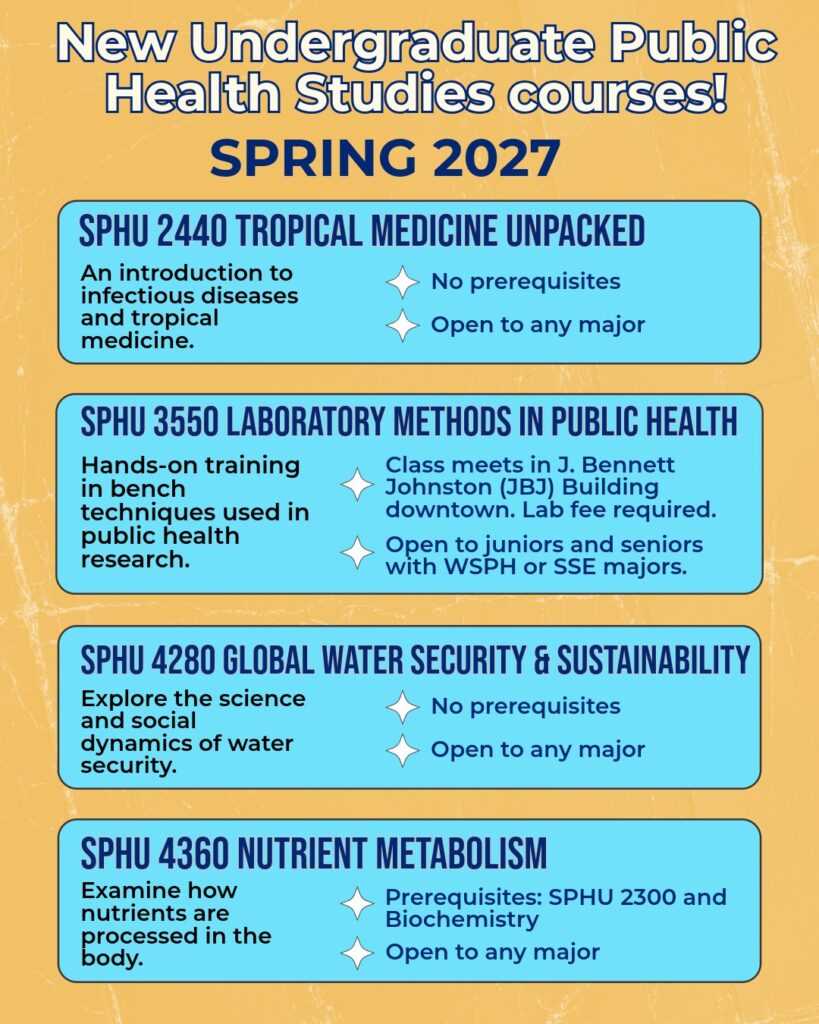
SPHU 2440 Tropical Medicine Unpacked (3 credits)
Tuesdays & Thursdays, 8:00AM – 9:15AM
This course surveys tropical infectious diseases, emphasizing evolving concepts of disease, biology, epidemiology, and public health impact. Students will learn why tropical medicine emerged as a distinct field shaped by infectious disease patterns, geography, and colonial economic systems. The course examines how economic priorities and constructed racial categories intersected with the biology of infection to define the discipline. It also introduces major pathogen classes and the broad social consequences of infectious diseases, which influence public health more visibly than most other conditions. Through foundational scientific content and practical case studies, the course prepares students for advanced work in global health, engineering, biology, or medicine.
• No prerequisites
• Open to any major
SPHU 3550 Laboratory Methods in Public Health (3 credits)
Mondays, 3:00PM – 5:30PM
This laboratory course provides hands-on training in bench techniques used in public health research. Designed for advanced undergraduate students with limited or no prior laboratory experience, the course systematically builds technical competency through weekly 3-hour laboratory sessions and integrated lectures. Several lab techniques will be covered (PCR, microscopy, and cell culture) as well as Environmental Science Topics such as environmental Sample Collection and Toxicology. Students evaluate scientific literature to develop testable hypotheses, design and execute experiments, analyze and interpret results, and communicate findings in both written and oral formats.
• Open to juniors and seniors with majors in Weatherhead School of Public Health or School of Science & Engineering.
• Class will meet in J. Bennett Johnston (JBJ) Building downtown.
• A $100 lab fee is required.
SPHU 4280 Global Water Security & Sustainability (3 credits)
Tuesdays & Thursdays, 12:30PM – 1:45PM
This interdisciplinary course explores the science and social dynamics of water security, including water quality, access, reliability, and sustainability from source to household use from environmental, social- behavioral and health perspectives. Students will investigate how physical, chemical, microbiological, and human factors impact access to safe and sustainable water supplies. Key topics include common and emerging water pollutants, waterborne diseases, infrastructure and governance, and approaches for water security assessment and management. To bring these complex issues to life, the course will use real-world case studies, field-based examples, and interactive discussions. Students will engage in hands-on critical learning that bridges science and society. Designed for students from a range of disciplines, this course provides foundational skills for addressing global water challenges in both scientific and community-based contexts.
• No prerequisites
• Open to any major
SPHU 4360 Nutrient Metabolism (3 credits)
Mondays, Wednesdays, and Fridays, 11:00AM – 11:50AM
This course provides an in-depth examination of the digestion, absorption, transport, and metabolic regulation of macronutrients and micronutrients in the human body. Building on biochemical principles, students will explore how nutrients are processed and utilized at the cellular and systemic levels, with emphasis on energy production, nutrient interrelationships, and homeostatic control. Topics include nutrient requirements, metabolic adaptations, and the influence of genetics, microbiota, and lifestyle factors on nutrient metabolism. The course also introduces current research in areas such as nutrigenomics and metabolic health, with applications to chronic disease prevention and clinical nutrition.
• Prerequisites: SPHU 2300 and Biochemistry
• Open to any major
• Required course for Nutrition Science majors