
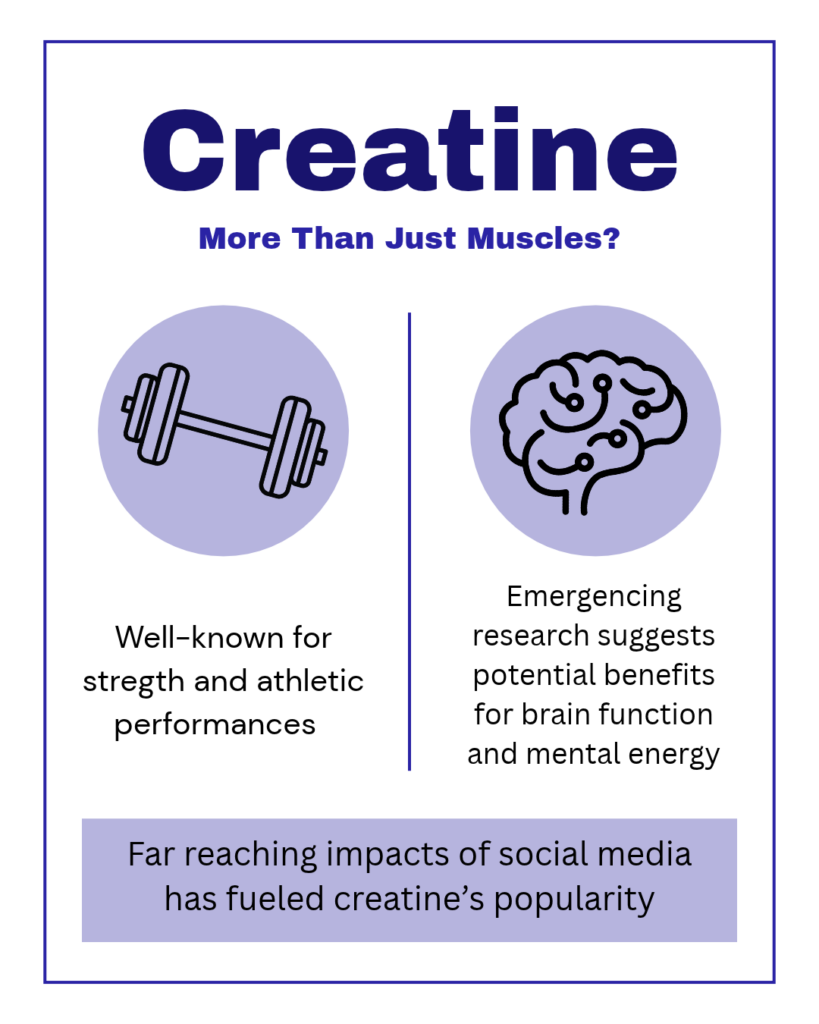
Creatine, a naturally occurring substance and a common performance supplement, has become increasingly popular amongst athletes and teens with reported uses starting as early as sixth grade (Children’s Hospital of Philadelphia). Creatine use among teenagers has increased as much as 168% over the past couple of years due to its reported benefits for muscle growth, strength, and athletic performance (CHP). This spike in popularity has been widely attributed to its recognition on social media platforms. It’s being marketed as a trendy, seemingly harmless supplement and an essential part of fitness routines, often promoted by influencers as a shortcut to achieving an ideal physique (Beos). As mentioned, your body naturally gathers its own source of creatine from foods like seafood and red meat with most of it being stored in your muscles and small amounts stored in your brain (Mayo Clinic). The body then uses creatine during short bursts of high-intensity activity, allowing you to have greater sources of energy for longer periods of time (Northwestern Medicine). Creatine becomes a last resort and additional support for your body once it burns through its ATP and ADP stores during these high-intensity periods (Northwestern Medicine). Studies carried out on adults show that creatine has few harmful impacts, with it being declared a safe and effective substance. However, taking creatine alone does not build muscle, but it enhances the muscle-building effects when paired with a consistent exercise routine (CHP). While creatine has been a long promoted natural supplement, its recent surge in popularity has sparked greater interest in its potential benefits beyond cognitive function, brain health and overall well-being. Creatine is used as a source for energy and the brain, one of the body’s most energy-demanding organs, accounts for around 20% of the body’s energy consumption with stores of creatine found in the brain (Smith). Thus, researchers have started to theorize that creatine supplementation may have the ability to energize brain cells improving people’s ability to think clearer and overcome fatigue (Smith). The issue is, while brains carry stores of creatine is much more “locked down” than the creatine produced by the liver and other parts of the body, it releases its stores at a much slower rate (Smith). Additionally, the creatine being carried to the brain is carried by a special transport protein in small amounts, meaning, if you increase the dose of creatine, it doesn’t necessarily mean the concentration of creatine in the brain will increase (Smith). Studies haven’t confirmed large amounts of change but some have found that supplementing creatine with a large dose of creatine can increase brain levels of the molecule by about 5 to 10 percent sparking promising potential of creatine impact on cognitive abilities (Dechent). While studies are starting to support these claims and further research is being carried out, it is within limits. Further support of this supplement on social media platforms has started to let hype get ahead of science. Creatine has shown promise in improving cognitive abilities but, the scientific evidence remains limited, particularly among teenagers, and the growing enthusiasm surrounding its potential benefits has outpaced researchers’ ability to fully understand its long-term effects.
Works Cited
Beos et. Al. PubMed, https://pubmed.ncbi.nlm.nih.gov/41905190/.
“Creatine Supplements: How To Build Muscle Mass Safely.” Northwestern Medicine, https://www.nm.org/healthbeat/healthy-tips/nutrition/creatine-supplements-how-to-build-muscle-mass-safely.
Dechent P. et. Al. American Journal of Physiology-Regulatory, Integrative and Comparative Physiology, vol. 277, no. 3, 1999, https://doi.org/10.1152/ajpregu.1999.277.3.R698.
Mayo Clinic Staff. “Creatine.” Mayo Clinic, https://www.mayoclinic.org/drugs-supplements-creatine/art-20347591.
Smith, Dana G. “Creatine Supplements and Brain Benefits.” The New York Times, 5 Nov. 2026, https://www.nytimes.com/2026/11/05/well/mind/creatine-supplements-brain-benefits.html.
Srinivasan, Vedant. “Creatine Use in Teens.” Children’s Hospital of Philadelphia, 29 July 2026, https://www.chop.edu/pediatric-health-chat/creatine-use-in-teens.